Separating two centuries of fact from a few decades of bad press. The numbers, the history, and the reality of living with these extraordinary dogs.
Any honest conversation about Staffies has to begin with this: any dog can bite. We're not here to pretend otherwise. But the conversation doesn't end there — it barely begins there.
When a Staffordshire Bull Terrier bites someone, it makes headlines. When a Labrador, a Jack Russell, or a Cocker Spaniel does the same, it usually doesn't. That asymmetry in coverage creates a distorted picture of reality that ends up costing thousands of innocent dogs their lives.
Let's look at what the evidence actually says.
Important context: We are not saying Staffies never bite, never cause injury, or that their strength is irrelevant. We are saying that the frequency of biting, the cause of aggression, and the treatment of the breed in public discourse are all profoundly misleading — and that has real consequences for real dogs sitting in rescue centres right now.
UK bite data — when it's properly broken down by breed population and incident frequency — tells a very different story to the tabloid version.
Here are the claims you'll hear most often about Staffies and pitbull-type dogs, and what the evidence actually shows.
| The Myth | The Reality |
|---|---|
| ❌ Staffies are naturally aggressive dogs | ✅ Staffies were selectively bred to be human-friendly. The Kennel Club describes them as "affectionate, loyal and loving family pets." Aggression towards people is contrary to their bred temperament. |
| ❌ They have "locking jaws" | ✅ No dog has a locking jaw mechanism. This is anatomically false. No veterinary or biological evidence supports this claim for any breed. |
| ❌ Staffies are the most dangerous breed in the UK | ✅ When adjusted for breed population, Staffies do not top bite statistics. Breeds like Jack Russells and Labradors are involved in more reported bite incidents, with Jack Russells particularly over-represented in bites to children's faces. |
| ❌ They're illegal in the UK | ✅ Staffordshire Bull Terriers are completely legal in the UK and not subject to breed-specific legislation. You may be thinking of the American Pit Bull Terrier, which is subject to the Dangerous Dogs Act — but a Staffy is a distinct, recognised breed. |
| ❌ They turn on their owners without warning | ✅ Dogs almost always display clear warning signs before biting. The problem is that humans — especially children — frequently don't recognise or respect canine body language. This is an education problem, not a breed problem. |
| ❌ Once they attack, they can't be stopped | ✅ A well-socialised, trained Staffy responds to commands. Unstoppable aggression in any breed is the result of abuse, neglect, deliberate training to fight, or extreme fear — not breed genetics. |
| ❌ They're not suitable for families with children | ✅ The Kennel Club gives Staffies their highest rating for compatibility with children. Their historical nickname is "the nanny dog." They have been family companions for over 200 years. |
The Staffordshire Bull Terrier as we know it today was developed in the English Midlands in the 19th century, originally bred from Bulldogs and terriers. Yes — their ancestors were used in blood sports, a shameful chapter of history that was outlawed in 1835.
But here is the critical point that gets consistently missed: even in those early days, the dogs were required to be handleable by humans. A dog that turned on its handler in the pit was useless and dangerous. So from the very beginning, human-friendliness was bred in, not out.
After blood sports were banned, the breed was adopted by working-class families across the Midlands and became the beloved companion and family dog it is today. The "nanny dog" nickname came precisely from this era — parents trusted Staffies to watch over their children.
The Kennel Club officially recognised the breed in 1935. Today's Staffy is the product of nearly two centuries of selective breeding for one primary purpose: being a wonderful companion to people.
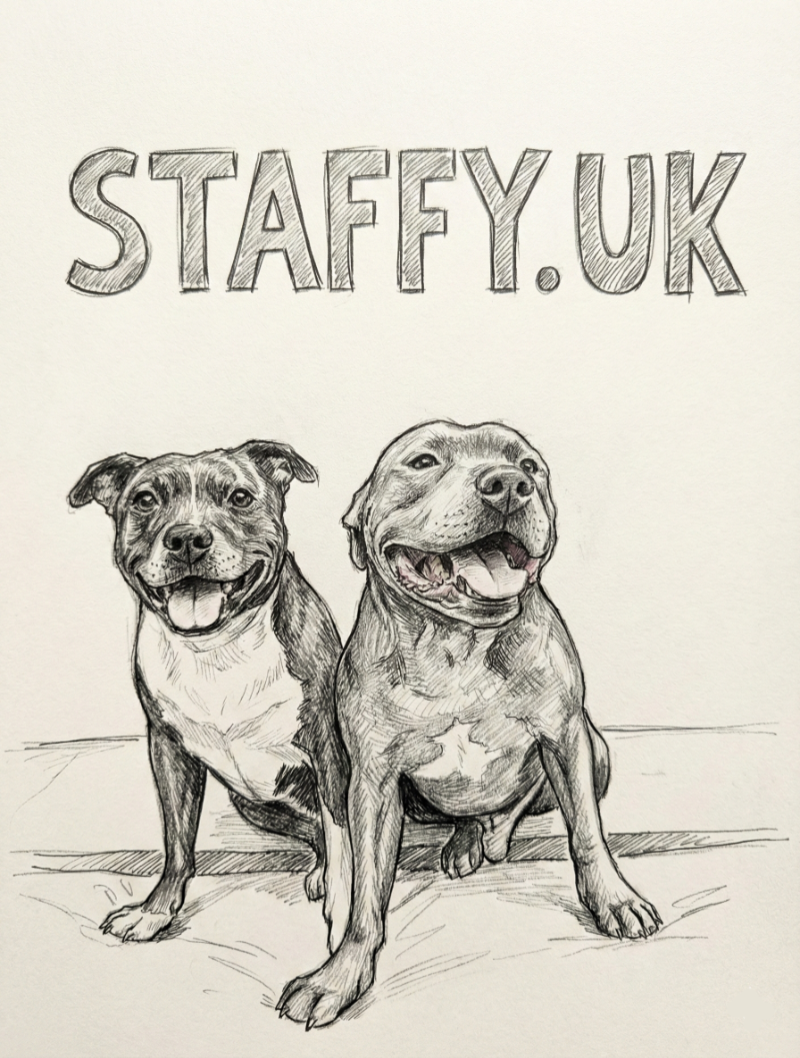
This is the conversation we actually need to have. Because yes — Staffies can, in the wrong hands, become aggressive. So can any dog. But because Staffies are so exceptionally eager to please, they are particularly susceptible to being misdirected by poor owners.
A Staffy will work tirelessly to make you happy. Give them love, consistency, and clear boundaries, and they will be the most loyal, gentle dog you have ever met. Give them abuse, neglect, and "training" aimed at building aggression, and their desire to please will work against them.
The problem is never the breed. The problem is always the owner. — A consistent finding across decades of canine behaviour research
The factors that reliably predict dog aggression — in any breed — are:
Dogs that have been physically abused, starved, or kept in isolation develop fear-based aggression. This is true of every breed without exception.
Some people deliberately train dogs to be aggressive using cruel methods. That any dog responds to such training is not evidence of breed dangerousness.
Dogs not properly socialised with other people, animals, and environments during puppyhood develop anxiety and fear responses that can manifest as aggression.
Any dog without clear, consistent guidance becomes anxious and unpredictable. Structure and boundaries are a form of care — not cruelty.
The bottom line: Address these four factors in any dog, of any breed, and you dramatically reduce the risk of aggression. Ignore them in a powerful breed and you create a dangerous situation. But the solution is tackling irresponsible ownership — not demonising an entire breed of dog that has spent 200 years earning our trust.
We've talked about how a Staffy's eagerness to please can, in terrible hands, be misdirected. But let's be clear about what that same trait produces in the right home.
Staffies will work harder than almost any other breed to make you happy. They are endlessly forgiving of their owners' mistakes. They will curl up with you when you're sad. They will play until they drop when you're energetic. They will greet you every single time you come home — even if you've only been gone five minutes — as though you've returned from a great adventure.
They will also, when it comes to it, put themselves between you and any danger without a second thought. Not because they've been trained to. Because you are their pack, and they would do anything for their pack.
That fierce loyalty is not a danger. In the right home, it is one of the most extraordinary things you will ever experience from an animal.
I was never a dog person. Then a Staffy came into my life. Now I can't imagine life any other way — or with any other breed. — Founder, Staffy.uk
If this page has changed how you think about Staffies, here's how to turn that into action.
Rescue centres across the UK are full of wonderful Staffies waiting for a family. Consider giving one a home before buying a puppy.
Find a Rescue →Can't adopt right now? A donation to a Staffy rescue charity directly funds care, rehoming, and advocacy for dogs in need.
Charities →Share accurate information when you see Staffy misinformation. The myths persist because they're repeated. So can the truth.
Share Our Posts →Join our newsletter for charity event announcements, rescue stories, and more myth-busting content.